
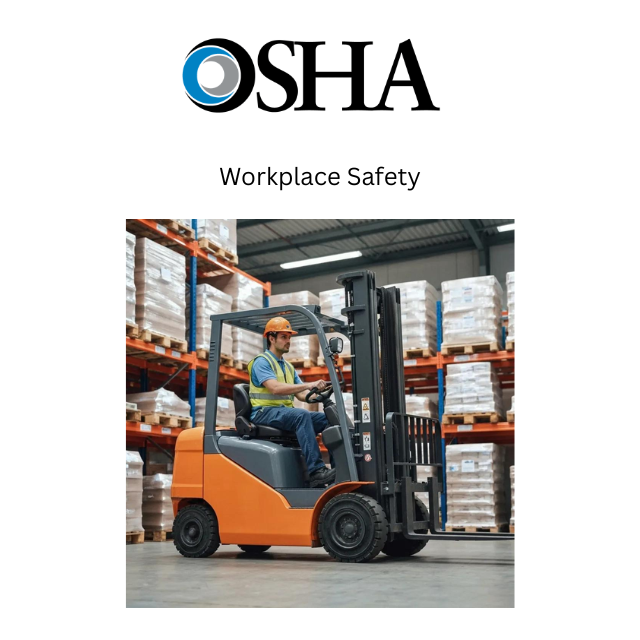
One of the most important OSHA requirements involves the person behind the controls.
Employers must ensure that each powered industrial truck operator is competent to operate the equipment safely. Training must include formal instruction, practical training, and an evaluation of the operator’s performance in the workplace.
Training needs to address both the equipment and the environment in which it will be used. Topics can include:
Training should therefore reflect the actual forklifts and working conditions employees encounter—not simply provide generic forklift instruction.
OSHA also requires an evaluation of each operator’s performance at least once every three years. Refresher training is required in circumstances such as unsafe operation, an accident or near miss, an evaluation revealing unsafe operation, assignment to a different type of truck, or changes in workplace conditions that could affect safe operation.
A forklift shouldn’t automatically go to work just because it starts.
Under OSHA’s powered industrial truck standard, industrial trucks must be examined before being placed in service. When forklifts are used around the clock, they must be examined after each shift. OSHA also provides sample daily inspection checklists as guidance for employers and operators.
A pre-operation inspection may include checking items such as:
The exact inspection will depend on the forklift and its power source. This is where a daily inspection can become much more than paperwork. A damaged fork, badly worn tire, weak horn, malfunctioning light, hydraulic leak, or other safety-related defect may be a warning that the truck shouldn’t be operating.
Finding a problem during an inspection is only useful if something is done about it. OSHA states that a powered industrial truck found to be defective, in need of repair, or unsafe must be taken out of service until it has been restored to safe operating condition.
That makes seemingly small problems worth taking seriously. For example, OSHA has specifically addressed deteriorated forklift horns. If a truck uses a horn as its warning device and the horn can no longer be heard above the ambient workplace noise, OSHA considers the truck unsafe.
A good facility safety process therefore needs a clear system for:
Inspect → Report → Remove from service when necessary → Repair → Return to service
Operators should also know exactly whom to notify when they find a defect.
Forklift warning devices are an area where OSHA requirements are sometimes misunderstood.
OSHA’s forklift safety guidance references the applicable powered industrial truck standards concerning an operator-controlled horn, whistle, gong, or other sound-producing device. OSHA also recognizes that additional audible or visual warning devices may be appropriate depending on the worksite.
A horn only helps, however, if people can hear it. Warehouses can contain conveyors, machinery, dock equipment, compressors, fans, trucks, and other sources of noise. Employers should consider whether existing warning systems are effective under actual operating conditions. A weak or damaged horn isn’t something to leave on a maintenance list indefinitely.
This is where it’s important to distinguish between a good safety practice and a universal OSHA requirement.
OSHA’s powered industrial truck standard does not simply require every forklift in every workplace to be equipped with an aftermarket backup alarm. Whether additional warning devices are needed can depend on the truck, applicable standards, manufacturer specifications, and hazards present at the particular worksite. OSHA’s guidance recognizes the use of additional sound-producing or visual warning devices where appropriate. That means employers should evaluate the actual risk.
Consider questions such as:
Do forklifts frequently reverse near pedestrians?
Are there blind intersections?
Is ambient noise high?
Are employees routinely working around moving forklifts?
Do loads restrict operators’ visibility?
Are trailers, docks or staging areas particularly congested?
A backup alarm can be one part of a broader pedestrian-safety strategy when conditions warrant it.
Blue spotlights, red zone lights, LED beacons, and other visual warning systems have become common forklift safety accessories. But installing a blue light shouldn’t be presented as an OSHA requirement for every forklift.
Instead, these devices can serve as supplemental warnings in workplaces where an employer determines additional visual warning is appropriate. OSHA’s powered industrial truck guidance specifically recognizes additional visual devices such as lights or blinkers where appropriate to the worksite.
For example, a blue warning light may help provide advance visual notice of an approaching forklift at:
Blind intersections
Cross aisles
Doorways
Racking aisles
Areas with frequent pedestrian traffic
Red zone lights can help visually establish a buffer alongside a moving forklift. These technologies should supplement—not replace—operator training, pedestrian procedures, horns, traffic controls and other appropriate safeguards.
Not every replacement part is automatically appropriate simply because it fits. OSHA requires replacement parts for industrial trucks to be equivalent as to safety with those used in the original design. This is especially important when replacing safety-related components such as:
Horns
Lights
Switches
Braking components
Forks
Tires
Electrical components
The goal isn’t simply to get the forklift moving again. The repair needs to restore the equipment to a safe operating condition.
Forklift safety doesn’t stop when the operator parks the truck. Battery charging and changing, propane handling, and gasoline or diesel fueling can introduce additional hazards. OSHA’s powered industrial truck standard contains specific provisions addressing battery charging and fuel handling, and other OSHA standards may also apply to employees performing maintenance.
For electric forklift operations, employers should pay attention to the condition of:
Battery connectors
Cables
Chargers
Battery restraints
Charging equipment
Charging areas
Employees involved in battery charging, fuel handling, or maintenance also need appropriate training for the tasks they perform.
OSHA’s forklift standard has some nuances regarding seat belts that are often oversimplified. OSHA’s enforcement guidance states that employers are obligated to require operators to use operator-restraint devices, including seat belts, when powered industrial trucks are equipped with them. Operator training should also address the manufacturer’s warnings and instructions concerning restraint systems.
Forklift tip-overs can happen quickly, and attempting to jump from a tipping sit-down forklift can expose an operator to serious injury.
If a truck was designed with an operator-restraint system, damaged or nonfunctional components shouldn’t simply be ignored.
Forklift safety isn’t only about protecting the operator. Facilities should consider how forklifts interact with pedestrians throughout the workday. OSHA notes that workplace conditions affect the hazards created by powered industrial trucks and that appropriate protections depend on both the truck and the worksite.
Look closely at areas such as:
Blind intersections
Dock areas
Doorways
Aisle crossings
Production areas
Shipping and receiving
Employee entrances
Break areas near forklift traffic
Physical barriers, marked pedestrian lanes, mirrors, signs, warning lights, alarms, speed controls, training and traffic procedures can all form part of a facility’s overall approach to reducing forklift-pedestrian risk.